In recent years, the "circular economy" has become a global concern, giving rise to numerous innovative business models. This shift has shifted from the traditional linear production model of mass production, mass consumption, and mass disposal to a continuous recycling and utilization of materials, forming a "resource, product, and renewable resource" cycle. This creates economic performance and fundamentally resolves the contradiction between economic development and environmental impact. However, due to the complexity of the circular economy and the numerous technical and regulatory barriers, many small and medium-sized enterprises still face significant barriers to entry in their innovative development.
In June 2017, the British Standards Institution (BSI) officially released the Circular Economy Guidance Standard (BS8001), the world's first circular economy standard. It champions the concepts and principles of a circular economy, guiding small and medium-sized enterprises (SMEs) to identify their relevance and potential areas of focus, thereby bridging the gap in circular production models. BS8001 is the first global framework and guidance for promoting a circular economy within organizations. It helps SMEs consider and promote circularity, review factory operations, and use systematic logic to revise their production models to achieve sustainable operations and ensure that products, parts, and materials maintain their highest value. It also accelerates SME transformation and helps them develop action plans to reap the benefits of a circular economy.
How to apply circular economy standards to create a mature business model. The key points of implementation are summarized as follows:
Establishing a systemic framework for operating a circular economy
The Circular Economy Guidance Standard (BS8001) provides an eight-stage, flexible framework to help SMEs develop plans for continuous improvement and transformation. This framework incorporates circular elements, and while the eight stages are presented sequentially, SMEs can cycle back and forth between them as their circular maturity develops. The eight-stage flexible framework of the Circular Economy Guidance Standard (BS8001) is as follows:
Phase 1: Framing
Phase 2: Scoping
Phase 3: Idea generation
Phase 4: Feasibility
Phase 5: Business case
Phase 6: Piloting and prototyping
Phase 7: Delivery and implementation
Phase 8: Monitor, review, and report
Six Principles
SMEs can create long-term operational value by utilizing six principles and designing their products or services for sustainable management. These six principles include:
System Thinking: SMEs understand how individual circular economy decisions and activities interact with the overall enterprise system from a macro perspective.
Innovation: SMEs continuously innovate and create enterprise value through the sustainable management of product and service resources.
Stewardship: SMEs manage the direct and indirect impacts of their decision-making activities on operational performance within the system.
Collaboration: Formal and informal communication and coordination, working with internal and external organizations to create shared enterprise value.
Value Optimization: Maintaining the maximum value and performance of products, components, and materials at all times.
Transparency: Maintaining an open attitude towards decisions and activities that affect the SME's ability to transition to a more sustainable and circular operating model, and being willing to communicate in a clear, accurate, timely, honest, and complete manner.
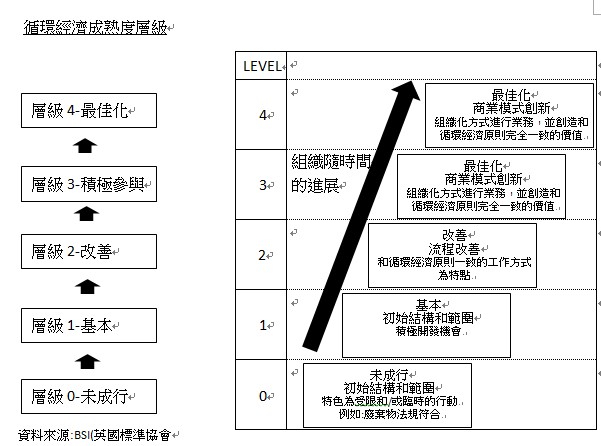
Maturity Levels: After completing the circular economy system framework, SMEs can use 79 questions based on the six principles of circular economy to assess the maturity of their current circular economy decisions and activities. Maturity levels are categorized into five levels:
Level 0: Unformed
Level 1: Basic
Level 2: Improving
Level 3: Engaged
Level 4: Optimizing
The new business model of the circular economy goes beyond simply recycling and reusing waste. It aims to redefine waste, redesign products, and processes, allowing resources to continuously circulate within the supply chain, reducing energy consumption and waste generation. Yu Zong Company is committed to energy conservation, environmental protection, and carbon reduction in its paper and printing processes. Through a program sponsored by the Ministry of Economic Affairs' Small, Medium, and New Enterprises Administration, Yu Zong worked with the Plastics Center to develop a "water-based printing recycling control system" and a "wastewater treatment agent." These technologies effectively reduce ink consumption, wastewater volume, air compressor power, and labor costs by over 70%. Yu Zong has received circular economy certification and has attracted interest from businesses in China, South Korea, and Southeast Asia.